
Perfectly Imperfect 🍃🫒🕊️
The Grace of the Knobbly Olive Tree


“In nature, nothing is perfect; and everything is perfect. Trees can be contorted, bent in weird ways, and they're still beautiful.”- Alice Walker
Roquebrune-Cap-Martin may be best known for its glittering coastline, but a short wander inland reveals a subtler beauty: a grove of olive trees, some many centuries old, basking in the Mediterranean sun. Their trunks are twisted and bent in strange, striking ways, each one uniquely shaped by the wind, soil and time itself. These trees don’t follow symmetry or perfection. They follow life.
I was struck by their beauty. There was something captivating in their irregularity that brought to mind wabi-sabi, a Japanese aesthetic and intuitive way of living that finds beauty in imperfection, impermanence and the natural cycles of life. Wabi-sabi teaches us to recognize that a crooked branch, a weathered trunk, or holes in the bark tell a deeper story. And perhaps more than anything, it’s a reminder that everything is always in motion.
Nature doesn’t aspire to permanence. Trees grow, they shed and adapt. Flowers burst into bloom, only to fade. Streams carve new paths. Seasons come and go. And it’s in this very transience that beauty lives.
And yet, much of modern life is built on the illusion that we can outwit change as it pulls us away from those natural rhythms. We try to halt aging, optimize every moment and tighten our grip on what we think we can control. From industrial farming to cosmetic culture, we’ve structured entire systems to defy natural limits. But what’s sold as progress can become a kind of denial.
Monoculture farming, for example, disregards the biodiversity that nourishes and sustains the soil, gradually stripping away its resilience. This depletion of nutrients and the disruption of natural cycles eventually weakens the land, until eventually, it can no longer support what once thrived.
The ancient olive trees, still bearing fruit, make you reflect on how far we’ve drifted from nature’s ebb and flow. In our pursuit of permanence and productivity, we’ve designed lifestyles that isolate us from nature in all her unruly beauty, draining the planet’s energy as well as something vital within ourselves.
Contemporary culture tends to treat flawlessness (symmetry, smoothness, eternal youth) like a grand achievement we should all strive for. I’m not suggesting we embrace asymmetry in humans as a new aesthetic but the olive trees, with their weathered quirks, have something to teach us. Resilience doesn’t come from resisting change, but from moving with it. Their beauty comes from everything they’ve lived through – a strength rooted in acceptance and a sort of unpolished grace.
And even the olive trees, for all their stoic resilience, don’t last forever. In one corner of the grove, the trunks of long-felled trees stood like sculptures, their tops cut off, but their gnarled forms still full of personality. Wabi-sabi doesn’t just honor imperfection; it honors impermanence. It nudges us to savor what’s alive right now, knowing it won’t last and to maybe even feel okay with that. Because the rhythm of life includes blooming and bearing fruit, but also pruning, pausing and letting go.
And yes, even amidst the Riviera’s dazzle, it's the knobbly old olive tree that stays with you. ✨💚🌿
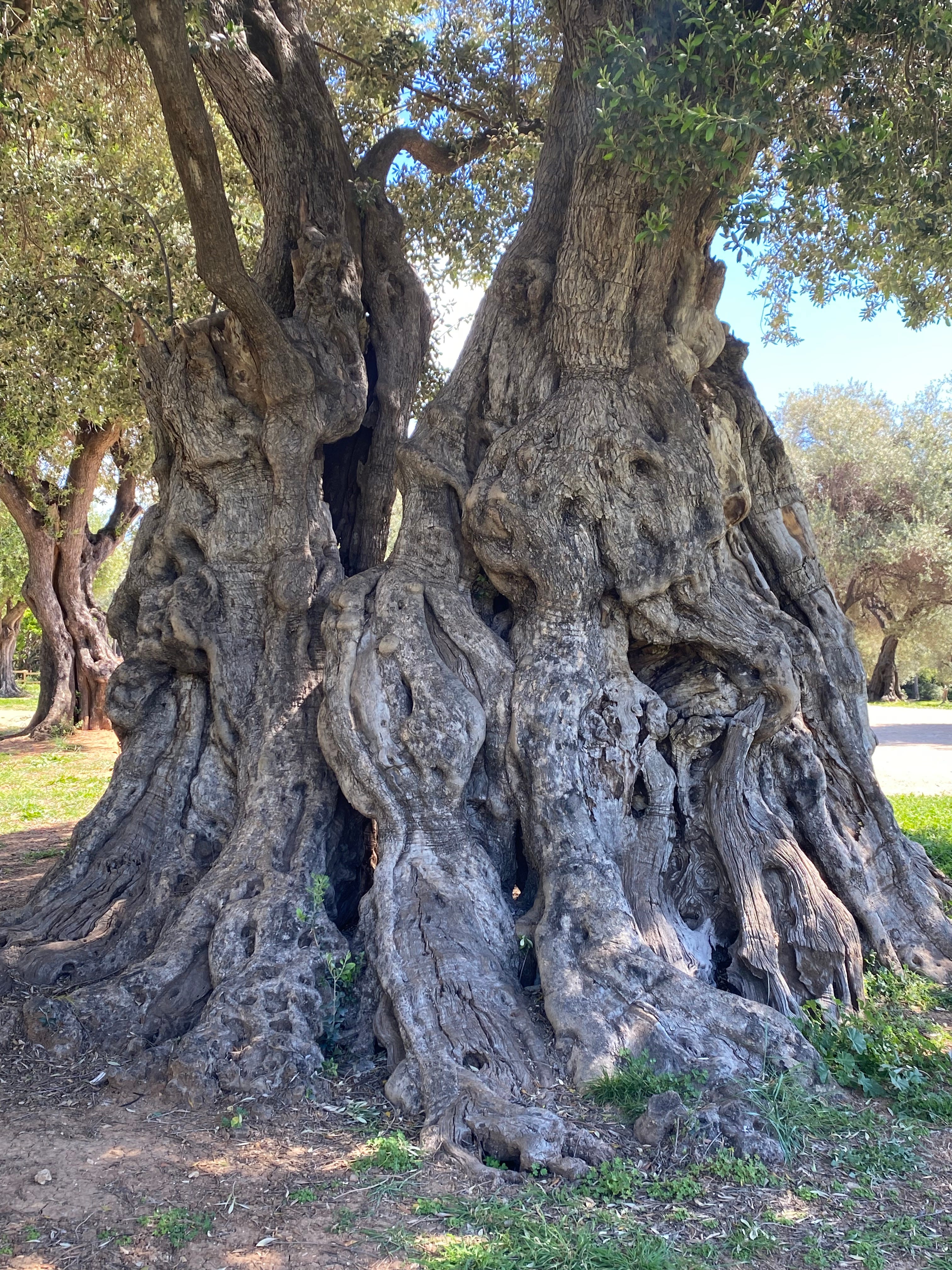
All photographs by Anjou Dargar.